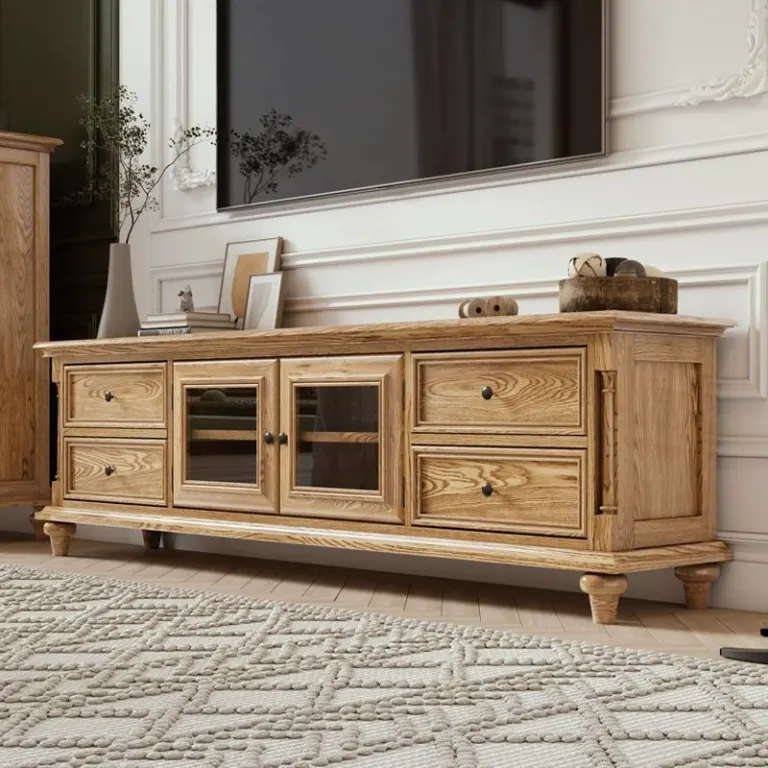
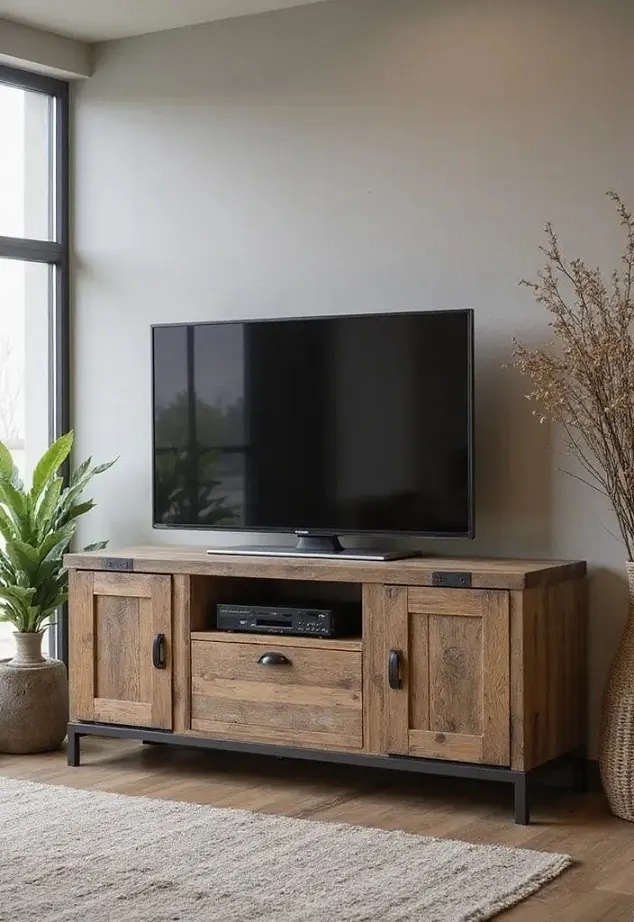
Bespoke Solid Wood TV Units: Architectural Millwork, Load-Bearing Engineering, and Modern Home Theater Integration
Designing and specifying bespoke solid wood TV units transforms a living room from a simple media space into an architecturally cohesive, acoustically balanced environment. Unlike flat-pack entertainment centers built from veneered particleboard or medium-density fiberboard (MDF), bespoke solid wood TV units are engineered to handle the extreme static loads of oversized OLED panels, dissipate the thermal output of high-current AV amplifiers, and adapt gracefully to decades of seasonal humidity shifts. This technical guide explores the millwork specifications, timber mechanics, floating installation physics, and ergonomic proportions that define high-performance bespoke solid wood TV units.

1. Architectural Millwork vs. Mass-Produced Media Consoles
In commercial furniture manufacturing, the phrase "solid wood" is frequently diluted to describe thin hardwood face frames glued onto composite cores. True bespoke solid wood TV units are constructed using solid timber throughout the primary carcass, horizontal slabs, drawer boxes, and base structure.
Why Solid Hardwood Outperforms Composite Cores
• Creep Resistance Under Sustained Load: Particleboard and MDF are viscoelastic polymers bound by urea-formaldehyde resins. Under the continuous downward force of an 85-inch television and a 25 kg AV receiver, composite shelves undergo permanent plastic deformation (creep) within 18 to 36 months. Dense hardwoods resist creep across wide unsupported spans.
• Fastener Retention and Hardware Longevity: Soft-close European hinges and full-extension undermount drawer slides rely on screw threads biting into dense wood fibers. Hardwoods provide superior screw-withdrawal resistance compared to crushed wood-chip substrates.
• Acoustic Mass and Damping: Hollow or low-density composite panels act like drumheads when excited by low-frequency subwoofer waves. Heavy, closed-pore hardwoods absorb kinetic energy and eliminate sympathetic cabinet buzz.
• Generational Refinishability: Because the timber is solid through its entire thickness (typically 28 mm to 40 mm), deep scratches, heat rings, or sun-faded surfaces can be sanded down and refinished decades later—an impossibility with 0.6 mm commercial veneers.
2. Timber Selection Matrix for Bespoke Solid Wood TV Units
Selecting the right timber species for bespoke solid wood TV units requires balancing mechanical strength, grain figure, seasonal movement ratios, and color evolution under indoor lighting.
Hardwood Species Janka Hardness (lbf) Tangential-to-Radial Shrinkage Ratio (T/R) Specific Gravity (12% MC) Key Engineering & Aesthetic Characteristics
Quarter-Sawn White Oak (Quercus alba) 1,360 1.8 (Low distortion) 0.68 Exceptional stability, prominent medullary ray fleck, high moisture resistance
American Black Walnut (Juglans nigra) 1,010 1.4 (Very stable) 0.55 Deep chocolate heartwood, resists warping near warm electronics, machines cleanly
European Ash (Fraxinus excelsior) 1,320 1.7 (Moderate-Low) 0.60 High elasticity and shock resistance, bright creamy-blonde grain for modern interiors
Hard Sugar Maple (Acer saccharum) 1,450 2.0 (Requires strict kiln control) 0.63 Extreme surface dent resistance, ultra-fine uniform pores, clean minimalist aesthetic
African Mahogany / Khaya (Khaya ivorensis) 830 – 1,070 1.4 (Very stable) 0.50 Interlocked ribbon grain, lightweight strength for floating wall-mounted units
Black Cherry (Prunus serotina) 950 1.9 (Moderate) 0.50 Silky closed grain, develops a deep reddish-amber patina over 24 months
Understanding the T/R Shrinkage Ratio
When evaluating timber for bespoke solid wood TV units, the Tangential-to-Radial (T/R) shrinkage ratio is just as important as Janka hardness. Wood shrinks roughly twice as much tangential to the growth rings as it does radially across them. Species with a low T/R ratio—such as American Black Walnut (1.4) or Quarter-Sawn White Oak (1.8)—stay flat and resist cupping even when indoor relative humidity swings between dry winter heating and humid summer weather.
3. Structural Engineering: Wide Spans, Stave Gluing, and Floating Mounts
Modern living rooms routinely feature bespoke solid wood TV units spanning 200 cm to 300 cm (79 to 118 inches) to visually anchor large-format displays. Spanning these distances without structural failure demands deliberate woodworking engineering.
Alternating Growth-Ring Stave Construction
A wide solid wood top is never milled from a single massive log slab unless stabilized with steel, as wide flat-sawn planks naturally cup away from the heartwood center. Master cabinetmakers mill kiln-dried timber (at 6% to 8% moisture content) into narrow staves measuring 65 mm to 110 mm (2.5 to 4.3 inches) wide. By alternating the end-grain growth-ring orientation (smile up, smile down) across adjacent staves and bonding them with Type III cross-linking PVA adhesive, internal wood stresses cancel each other out, keeping the top dead flat.
Cantilevered & Floating Wall-Mounted Engineering
Wall-mounted bespoke solid wood TV units create an airy, unobstructed floor plane, but they introduce severe shear and pull-out forces on wall framing:
1. Heavy-Duty French Cleats vs. Concealed Steel Brackets: For floating units exceeding 180 cm in length, standard wooden French cleats should be paired with continuous 6 mm thick structural steel L-brackets or heavy-gauge aluminum interlocking rail systems anchored directly into wall studs or solid masonry every 40 cm (16 inches).
2. Torsion-Box Subframes: To prevent sagging along the front edge of a floating console, builders integrate a concealed hardwood torsion grid beneath the cabinet floor, transferring bending moments back into the wall-mounted ledger rail.
3. Load Rating Verification: A properly anchored floating solid wood console must support at least 120 kg to 180 kg (265 to 400 lbs) of combined static cabinet mass and audio-visual equipment.
Floor-Standing Base Reinforcement
For freestanding bespoke solid wood TV units wider than 160 cm:
• Recessed Center Plinth or Fifth Leg: A concealed center support leg with a threaded brass or steel leveling glide prevents mid-span deflection over time.
• Mortise-and-Tenon Base Cradles: Leg frames built with haunched mortise-and-tenon joinery lock longitudinal stretchers to vertical legs, preventing racking (side-to-side wobble) when heavy equipment is shifted.
4. Home Theater Integration: Acoustics, IR/RF Signals, and Thermal Airflow
High-end bespoke solid wood TV units must perform as functional equipment racks without looking like studio hardware. Integrating modern AV gear requires solving three physical challenges: heat buildup, remote-control signal blocking, and acoustic interference.
Active and Passive Thermal Management
Class A/B home theater receivers, power amplifiers, and current-generation gaming consoles generate between 150W and 500W of continuous thermal energy.
• Chimney-Effect Convection: Design each equipment bay with a 40 mm (1.5 inch) intake gap along the bottom floor panel and a matching 40 mm exhaust slot along the upper rear edge. Cool room air enters from beneath the console, absorbs heat from the electronics, and rises naturally out the back.
• Whisper-Quiet Thermostatic Exhaust Fans: For fully enclosed bespoke solid wood TV units housing high-wattage amplifiers, integrate low-decibel (<18 dBA) 120 mm PWM fans equipped with thermal probes set to activate automatically when internal bay temperatures exceed 32°C (90°F).
Signal Transparency and Acoustic Fronts
Solid wood panels block infrared (IR) remote signals and muffle concealed speakers. Custom millwork resolves this through specialized door inserts:
• Vertical Acoustic Slats (Tambour or Louvered Fronts): Spaced 8 mm to 12 mm apart with a dark acoustic fabric backing, slatted hardwood doors allow IR beams and center-channel sound waves to pass cleanly while hiding cabling.
• Natural Rattan Cane Webbing: Hand-woven octagonal cane inserts set into mortised hardwood door frames provide 45% open airflow area, zero signal interference, and tactile organic warmth.
• Perforated Hardwood Grilles: CNC-milled geometric slot patterns offer durable, pet-proof ventilation for contemporary minimalist consoles.
Turntable and Vinyl Storage Considerations
Many homeowners incorporate analog hi-fi systems into bespoke solid wood TV units. Because vinyl records weigh roughly 20 kg per 30 cm (45 lbs per linear foot) of shelf space:
• Dedicate vertical cubbies with at least 34 cm × 34 cm (13.5" × 13.5") internal clearance.
• Place vinyl storage bays directly above vertical load-bearing dividers or floor legs rather than in the center of a floating span.
• Isolate turntables from subwoofer vibrations by resting the turntable plinth on a decoupled butcher-block platform fitted with Sorbothane hemispheres.
5. Ergonomic Proportions and Spatial Layout Guidelines
Even the finest craftsmanship falls short if the proportions of bespoke solid wood TV units clash with room scale or viewing ergonomics.
Viewing Height and Screen Centerline Alignment
• Eye-Level Rule: When seated on a standard sofa (seat height ~43–46 cm), human eye level sits at 100 cm to 108 cm (39 to 42.5 inches) above the floor.
• Console Height Calculation: Subtract half the height of your television screen from 104 cm to determine the ideal top height of your TV unit. For a 77-inch OLED (~96 cm tall), half the screen height is 48 cm—meaning the ideal console height is 50 cm to 56 cm (20 to 22 inches).
Width, Depth, and Wall Clearance Ratios
• Lateral Overhang: Extend the console 20 cm to 35 cm (8 to 14 inches) beyond both the left and right edges of the television screen to create a grounded visual pyramid.
• Functional Depth: Specify a minimum external depth of 45 cm to 50 cm (17.7 to 19.7 inches). Standard AV receivers measure 38 cm to 43 cm deep before accounting for rigid HDMI 2.1 connectors and banana-plug speaker terminals protruding from the rear chassis.
• Baseboard Scalloping: Have the back side panels notched (scribed) at the bottom rear corner to clear architectural wall baseboards, allowing bespoke solid wood TV units to sit completely flush against the wall without unsightly gaps.
6. Precision Finishes and Hardware Specifications
The tactile quality of bespoke solid wood TV units is defined by the finish chemistry and mechanical hardware selected during fabrication.
Low-VOC Penetrating Hardwax Oils vs. Catalyzed Finishes
• Zero-VOC Hardwax Oils: Formulated from linseed oil, sunflower oil, and hard carnauba/candelilla waxes, these finishes bond molecularly with the top wood fibers without forming a plastic surface film. They preserve the authentic grain texture of oak and walnut and allow effortless spot-repairs without sanding the entire top.
• Two-Component Waterborne Polyurethane: Ideal for high-traffic family rooms, modern 2K waterborne polyurethanes deliver commercial-grade resistance against spilled drinks, scratches, and UV yellowing while offering dead-flat (5° sheen) or satin (20° sheen) clarity.
Architectural Hardware Checklist
• Hinges: Specify 110° or 155° zero-protrusion soft-close concealed hinges (such as Blum CLIP top BLUMOTION) in onyx black or nickel finishes so doors open wide without obstructing pull-out equipment trays.
• Drawer Slides: Use undermount soft-close tandem slides rated for 45 kg (100 lbs) dynamic load, keeping steel runners hidden beneath solid dovetailed drawer boxes.
• Cable Management Grommets: Replace cheap plastic caps with milled solid brass, brushed stainless steel, or matching hardwood cable grommets fitted with brush seals to block dust while guiding cables cleanly through internal partitions.
7. Commissioning and Care Protocol for Bespoke Solid Wood TV Units
When commissioning bespoke solid wood TV units from a custom furniture maker or architectural millworker, request a detailed shop drawing confirming timber moisture content, board thickness, internal ventilation cutouts, and finish sheen samples prior to milling.
Once installed in your home:
1. Stabilize Indoor Climate: Keep indoor relative humidity within 35% to 55% across all seasons to prevent hairline end-checks or seasonal door binding.
2. Allow UV Patina Evenly: Rotate decorative objects, books, or soundbars occasionally during the first six months so natural ultraviolet light ages the timber surface uniformly.
3. Clean With pH-Neutral Care: Wipe surfaces weekly with a barely damp microfiber cloth along the grain direction, followed immediately by a dry lint-free towel. Never apply ammonia glass cleaners, abrasive pads, or silicone sprays.