Vessel Sink vs. Undermount Sink Distressed Solid Wood Bathroom Vanity Models: Ergonomics, Splash Dynamics, and Basin Pairing Engineering
Choosing between an above-counter vessel basin and a recessed undermount bowl fundamentally changes the proportions, daily maintenance, and waterproof longevity of distressed solid wood bathroom vanity models. While a sculptural vessel sink turns a reclaimed oak or hand-scraped walnut cabinet into an organic centerpiece, an undermount sink paired with a honed stone slab maximizes usable counter workspace and streamlines water wipe-downs. Because timber surfaces react differently to standing water droplets, soap runoff, and elevated faucet geometries than non-porous stone, aligning the basin architecture with the underlying wood joinery is essential.
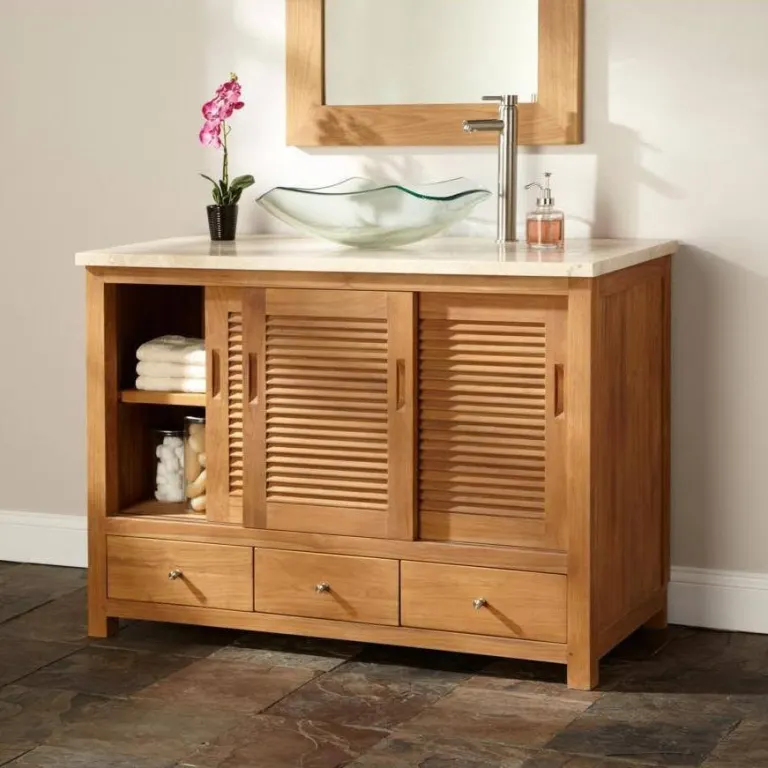
This technical guide examines the ergonomic height formulas, splash-zone fluid dynamics, countertop substrate protection, and basin material pairings for vessel sink vs. undermount sink distressed solid wood bathroom vanity models.
1. Ergonomic Height Formulas: Adjusting Cabinet Box Proportions
Standard architectural ergonomics place the comfortable hand-washing rim height of a bathroom basin between 85 and 90 centimeters (33.5 to 35.5 inches) above the finished floor. Failing to adjust cabinet box height when switching between undermount and vessel configurations results in awkward posture, wrist strain, and forearm water runoff.
• Undermount Sink Cabinet Height: Because the basin bowl hangs beneath the countertop surface, the distressed solid wood bathroom vanity model plus its 3-centimeter stone countertop should measure 85 to 88 centimeters total height (typically an 82–85 cm wood carcass + 3 cm stone slab).
• Vessel Sink Cabinet Height: Countertop vessel basins stand 12 to 18 centimeters tall above the deck. To keep the upper rim of the bowl within the ergonomic 85-to-90-centimeter window, the underlying distressed wood cabinet must be built significantly lower—typically 70 to 75 centimeters from the floor to the top of the wood slab.
Ergonomic & Structural Metric Undermount Sink Configuration Vessel Sink Configuration Architectural Impact
Target Basin Rim Height 85 – 88 cm from finished floor 86 – 90 cm from finished floor Prevents back strain and water running down elbows
Required Wood Carcass Height 82 – 85 cm (with 3cm stone top) 70 – 75 cm (accounting for 14cm bowl) Vessel vanities require bespoke lower cabinet proportions
Top Drawer Storage Volume Reduced (U-shaped cutout around deep bowl) Maximized (only a 45mm drain tailpiece passes through top) Vessel sinks preserve near-full-width top drawer storage
Countertop Wipe-Down Efficiency High (water wipes directly into bowl) Moderate (requires wiping around outer base crevice) Undermounts excel in high-traffic family bathrooms
Exposed Timber Top Feasibility Not recommended (requires stone/solid-surface slab) Viable with 2K catalyzed polyurethane + marine epoxy sealing Vessel sinks allow solid distressed timber tops
2. Splash Dynamics and Wood Surface Protection
Water behavior around the basin directly governs how long distressed solid wood bathroom vanity models retain their finish without swelling or staining.
Why Undermount Sinks Require Stone or Solid-Surface Countertops
Installing an undermount sink directly beneath a solid wood countertop leaves a perpetually wet horizontal end-grain rim exposed around the cutout opening. Even with heavy marine epoxy coatings, daily water splashes and wet soap contact eventually degrade the cutout edge. Therefore, undermount distressed solid wood bathroom vanity models should always pair a distressed timber cabinet carcass with a 3-centimeter natural stone (quartzite, granite, honed marble) or solid-surface slab, keeping the wood joinery safely below the wet counter plane.
Controlling Splash-Back on Vessel Sink Timber Tops
When a vessel sink rests atop a thick solid reclaimed-oak or distressed walnut counter slab, splash containment relies on three hydraulic details:
1. Faucet Spout Reach and Aerator Angle: The faucet stream must land directly over or slightly behind the center drain grid—never striking the flat bottom or steep side wall of a shallow vessel bowl, which causes ricochet splashing onto the wood deck.
2. Wall-Mounted vs. Tall Deck-Mounted Faucets: Wall-mounted faucets eliminate standing water puddles around a deck-mounted escutcheon ring on the wood surface. If using a tall single-hole deck faucet, seal the faucet mounting hole with two coats of marine epoxy and bed the base gasket in neutral-cure silicone.
3. Silicone Base Fillet: Run a neat, micro-thin bead of clear or color-matched sanitary silicone around the base ring where the vessel sink meets the sealed wood slab so water droplets cannot wick underneath the bowl by capillary action.
3. Basin Material Pairings for Distressed Timber Aesthetics
Matching basin textures with aged wood grain prevents visual clashes between ultra-modern glossy plastics and organic rustic joinery.
Best Vessel Basin Materials for Distressed Wood Vanities
• Hand-Hammered Copper or Brushed Bronze: Living-finish metallic vessels develop warm amber and dark espresso patinas that harmonize naturally with knotty white oak, walnut, and reclaimed barn pine while offering natural antimicrobial properties.
• Chiseled River Stone, Basalt, or Honed Travertine: Rough-hewn exterior stone bowls with polished interiors echo the tactile contrast of hand-scraped timber, anchoring organic spa and mountain-lodge interiors.
• Matte-Glazed Fireclay or Thin-Rim Matte Ceramic: Available in earthy tones (warm sandstone, charcoal, travertine cream, and soft bone), matte ceramic avoids the harsh glare of glossy white porcelain while resisting scratches and cosmetic stains.
Best Undermount Basin Styles for Stone-Topped Distressed Vanities
• Rectangular Zero-Radius or Soft-Corner Porcelain Bowls: Installed beneath honed Taj Mahal quartzite or leathered black granite, crisp rectangular undermount sinks balance the rustic texture of a distressed wood cabinet with clean transitional geometry.
• Apron-Front (Farmhouse) Fireclay Sinks: A fluted or smooth white fireclay apron-front basin set into a notched distressed solid wood cabinet brings authentic heritage character while shielding the front center wood rail from wet hands and dripping water.
4. Plumbing and Top-Drawer Storage Trade-Offs
Internal drawer capacity is an often overlooked difference between vessel sink vs. undermount sink distressed solid wood bathroom vanity models:
• The Vessel Sink Storage Advantage: Because the entire vessel bowl sits above the countertop, only a slim 32mm or 40mm tailpiece and pop-up drain assembly penetrate the top deck. When paired with a rear-offset P-trap, the top drawer beneath a vessel sink loses almost zero interior volume—delivering wide, uninterrupted compartmentalized storage for cosmetics and grooming tools.
• The Undermount Sink Carcass Requirement: An undermount bowl drops 18 to 22 centimeters down into the upper cabinet cavity, requiring either a false decorative tilt-out drawer front at the top tier or a deep U-shaped structural cutout in the upper dovetail drawer box.
5. Summary Selection Matrix: Which Configuration Fits Your Project?
• Choose an Undermount Sink Distressed Wood Vanity if: The vanity serves a high-traffic master bath or family bathroom, countertop wipe-down speed is a top priority, you are topping the wood carcass with natural stone or quartz, and you prefer a clean, uninterrupted mirror sightline.
• Choose a Vessel Sink Distressed Wood Vanity if: You want an authentic solid distressed timber countertop slab without stone, you are designing a guest powder room or boutique spa bathroom, you need maximum top-drawer storage capacity, or you want a sculptural stone, copper, or matte ceramic basin to serve as an architectural focal point.